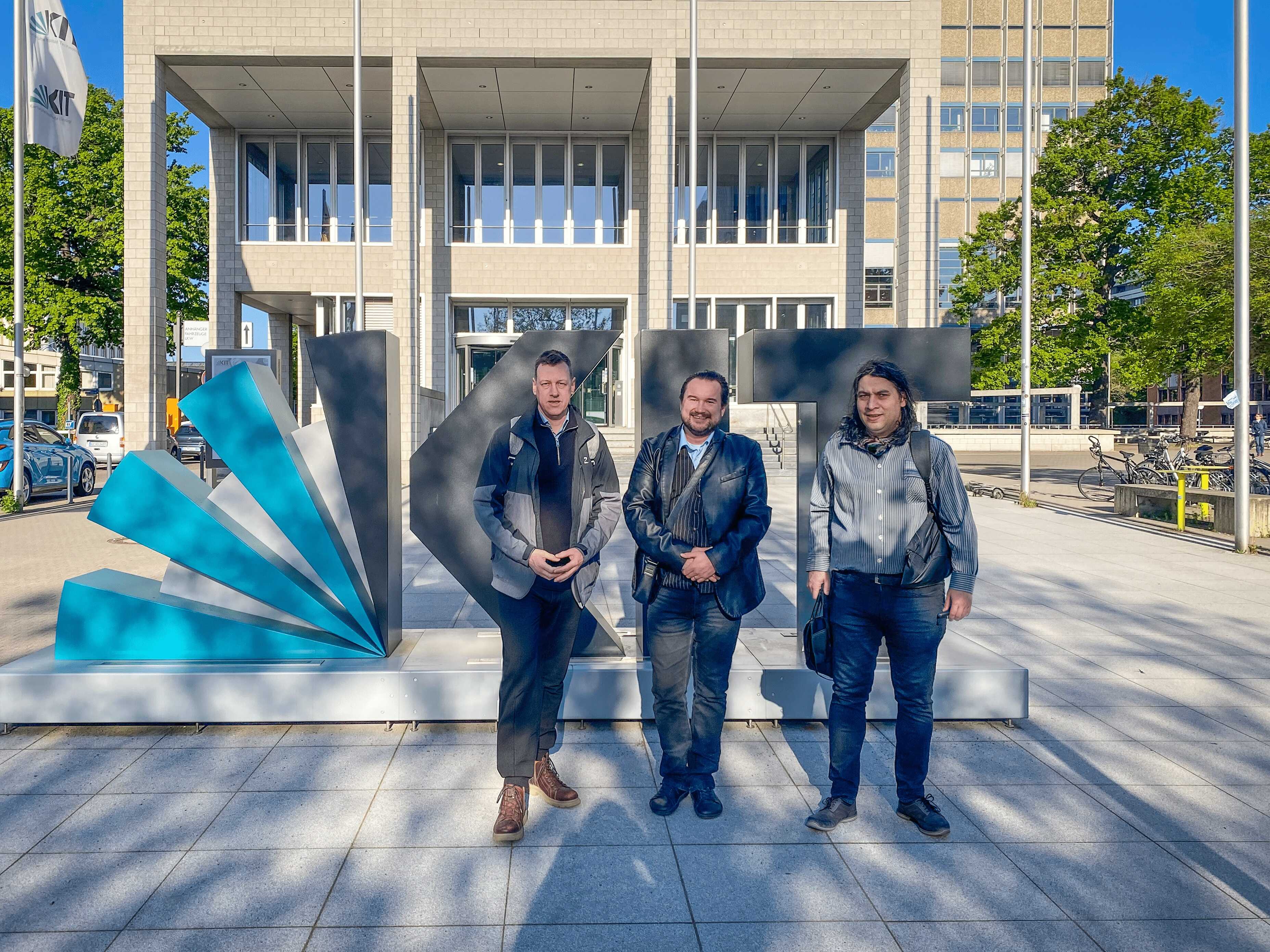
The Kadi4Mat Community Meeting 2026 focused on the practical application of electronic lab notebooks, research data governance, and methodologies to streamline documentation processes for scientific inquiries.
Alexandr Martaus, Tomáš Heryán, and Daniel Cvejn engaged in various workshops specifically designed to enhance proficiency with Kadi4Mat electronic lab notebooks. With these instruments, one can notably accelerate the preparation, documentation, and dissemination of experimental data in research activities.
Electronic lab notebooks (ELNs) are increasingly replacing conventional paper records and scattered files archived in heterogeneous formats. Their principal advantage lies in their capacity to facilitate a standardized articulation of the scientific methodology, documentation of the apparatus employed, measurement parameters, input data, and experimental outcomes. This not only conserves considerable time but, more critically, enhances the ease of revisiting completed measurements, assessing their progression, and building upon antecedent research.
Kadi4Mat provides an ecosystem where researchers can use pre-configured templates tailored to specific experimental types and measurements. This functionality proves particularly advantageous for repetitive protocols or experiments executed on a predetermined apparatus. Consequently, the research team is relieved of the obligation to generate documentation anew with each instance, thereby concurrently mitigating the risk of omitting crucial information from the record.
The significance of electronic lab notebooks is also increasing considering open-science mandates. The landscape of scientific work increasingly requires specific processes that are meticulously recorded, preserved, and disseminated in ways that uphold reproducibility and enable the reuse of data. Kadi4Mat empowers users to generate a structured ZIP file for selected data and disseminate it, for instance, via the Zenodo repository directly from within the application.
Participation in the meeting in Karlsruhe thus represented not merely an opportunity to acclimate oneself to the tool's technical attributes but also a forum for exchanging experiences with fellow users. For research institutions such as CEET, these systems can be pivotal for formulating new projects, managing experimental data, and establishing standardized protocols across research teams.
“ELNs elevate itself beyond merely being a digital counterpart to a paper notebook. It serves as a mechanism to better sustain the interconnections among the experiment, the apparatus used, the scientific data, and their subsequent analysis. It is precisely this continuity that is gaining increasing importance for contemporary research. Furthermore, Kadi4Mat reduces the bureaucratic requirements that open science now poses to researchers,” asserted Tomáš Heryán, Data Steward & Open Science at CEET.
The insights gained during the Kadi4Mat Community Meeting 2026 can be leveraged to formulate new CEET research projects, particularly in contexts that require managing substantial quantities of experimental data, ensuring their clear documentation, and preparing them for subsequent use in accordance with the principles of open science.